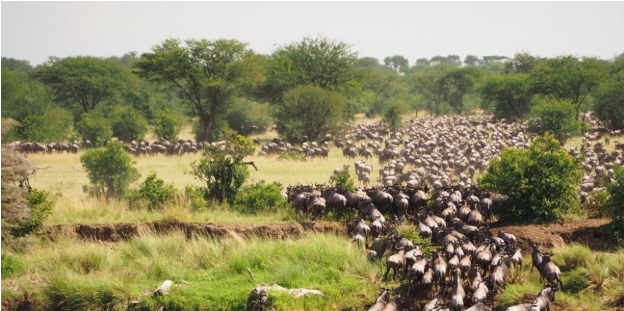
More than a million animals. An ancient, unstoppable circuit. No conductor, no destination, no end. The Great Migration does not perform for human audiences — it simply continues, as it has for hundreds of thousands of years, and we are privileged to watch.
Introduction
There are moments in wildlife travel that exceed language. The calving plains of the Southern Serengeti in February, when the short grass is green and dense with newborn wildebeest and the air hums with the calls of thousands of animals. The western bank of the Mara River in August, when a million-strong herd stands at the water’s edge in collective hesitation before the first animal plunges and the crossing begins — dust, crocodiles, chaos, and the raw, desperate physics of survival playing out in front of you in real time. These are not experiences that can be adequately described. They must be witnessed.
The Great Wildebeest Migration is the largest overland mammal migration on Earth — an annual circular movement of more than 1.5 million wildebeest, 400,000 zebra, and 300,000 Thomson’s and Grant’s gazelle through the Serengeti-Mara ecosystem of northern Tanzania and southern Kenya in an endless, rainfall-driven pursuit of fresh grass and water. No other wildlife event combines such overwhelming scale with such consistent, year-round drama. No other destination concentrates so many extraordinary experiences — calving, predator hunts, river crossings, vast plains filled horizon to horizon with moving animals — within a single ecosystem accessible to safari travellers.
Planning a Serengeti migration safari requires understanding the Migration not as a single event occurring at a fixed time and place, but as a continuous, seasonally structured process that offers distinct and extraordinary experiences in different zones of the ecosystem at different times of year. The right itinerary, matched to your travel dates and calibrated to the Migration’s seasonal position, can deliver one of the most profound wildlife encounters available anywhere on the planet.
This guide provides everything you need to understand, plan, and experience a Serengeti migration safari with the depth and precision that this extraordinary natural phenomenon deserves.
Understanding the Great Migration
The Science of the Circuit
The Great Migration is driven by a single, non-negotiable ecological imperative: the wildebeest must follow the rain. Specifically, they follow the growth of short, nutritious grass that follows rainfall across the Serengeti-Mara ecosystem — a vast landscape whose varying topography, soil chemistry, and rainfall patterns create a seasonal succession of productive grazing areas that the wildebeest, zebra, and gazelle exploit in a roughly clockwise annual circuit.
The circuit is not rigidly fixed — its timing and routing vary year to year in response to actual rainfall patterns, which can advance or delay the herds’ movement by weeks. But its broad seasonal structure is consistent enough to allow reliable safari planning, and understanding that structure is the foundation of every great migration safari itinerary.
The wildebeest are guided not by memory or leadership but by a collective biological response to grass availability, water scent, and the instinctive pressure of millions of animals moving in the same direction. There is no alpha animal directing the herd. There is no migration plan. There is simply the grass, the rain, and the relentless biological momentum of one and a half million animals following their instincts across a landscape that has been sustaining this circuit for hundreds of thousands of years.
The Migration’s Seasonal Calendar
November to December — The Southern Movement
As Tanzania’s short rains arrive in November, the wildebeest herds begin their southward movement from the northern Serengeti and the Masai Mara, drifting through the eastern Serengeti toward the short grass plains of the south. This period offers excellent general wildlife viewing with significantly fewer visitors than the peak seasons, and the fresh green landscape created by the short rains produces some of the most photogenic conditions of the year. Herds are dispersed but moving with purpose, and predator activity is high as the carnivore community follows the movement south.
January to March — The Calving Season
The wildebeest arrive on the short grass plains of the Southern Serengeti and the Ndutu area — the mineral-rich, nutritious grasslands that lactating females require to sustain newborn calves — and the calving season begins in earnest around late January. Approximately 500,000 calves are born within a two to three week window, an event of extraordinary biological intensity driven by the evolutionary advantage of synchronised birth: predators can only eat so many calves simultaneously, and the flood of new life overwhelms their capacity.
The calving plains in January and February are among the most extraordinary wildlife environments in Africa. Lions, cheetahs, leopards, hyenas, jackals, and wild dogs converge in their highest annual densities. Calves that can run within minutes of birth may still fall to a coalition of cheetahs or a clan of spotted hyenas within their first hour of life. The predator-prey dynamic here is not backdrop — it is the main event, playing out across the plains with relentless, unsentimental precision.
The light in the southern Serengeti during this period is exceptional for wildlife photography — clear skies, the low angle of the East African sun, and an unobstructed horizon that extends in every direction create conditions that professional wildlife photographers consider among the finest in the world.
April to May — The Long Rains and Western Movement
As Tanzania’s long rains arrive in April, the wildebeest begin their northward and westward movement, streaming through the Central Serengeti in massive columns and funnelling into the Western Corridor — the tongue of the Serengeti that extends westward toward Lake Victoria. The landscape is verdant and dramatic, and the sheer visual scale of a million-plus animals moving across a green and cloud-shadowed savannah is overwhelming.
The Grumeti River crossings of the Western Corridor provide the first major water obstacle of the northward migration. Less celebrated than the Mara River crossings but no less dramatic in their own right, the Grumeti crossings feature enormous resident Nile crocodiles — among the largest in Africa — that have spent months in the river waiting for this precise moment. Dramatic confrontations between crossing wildebeest and these ancient predators are a reliable feature of the May to June Western Corridor safari experience.
April and May are Tanzania’s wettest months, and some tracks in lower-lying areas can become challenging. However, the landscape is extraordinarily beautiful, accommodation rates drop significantly, and the wildlife viewing — particularly for the moving herds and their predator entourage — is excellent.
June to July — The Northern Migration Begins
By June, the long rains taper and the wildebeest complete their passage through the Western Corridor, beginning their movement north through the central and eastern Serengeti toward the Northern Serengeti and the Kenyan border. This transitional period offers excellent game viewing across a broad front as the herds spread across the central Serengeti’s woodland zones, and the dry season’s improving road conditions make this a productive and logistically straightforward period for safari travel.
July to October — The Northern Serengeti and Mara River Crossings
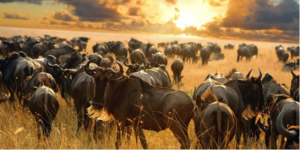
The Migration reaches its most celebrated and dramatic phase between July and October, when the wildebeest herds concentrate in the Northern Serengeti — the Lamai Wedge, the Mara River area, and the grasslands north of the Lobo hills — and begin the repeated attempts to cross the Mara River that have made this one of the most iconic wildlife spectacles in the world.
The Mara River crossings are not predictable on a day-by-day basis. The herds may build on the riverbank for hours — massed, agitated, individual animals breaking toward the water before veering away — before a single animal finally commits and the crossing begins in an avalanche of movement. Or they may cross suddenly and without apparent warning. The unpredictability is part of the experience: it requires patience, presence, and a willingness to spend extended hours at the river absorbing the atmosphere of anticipation that builds in the hours before a crossing.
When a crossing happens, the sensory experience is overwhelming. The sound alone — thousands of hooves striking water, the bellowing of panicked animals, the explosive strike of a crocodile — carries across the savannah for hundreds of metres. Crocodiles attack from below and from the sides, their extraordinary bursts of speed in the water belying their apparently somnolent riverbank posture. Wildebeest fall, are dragged under, and disappear. Others make the opposite bank and scramble up through the mud. The crossing ends as suddenly as it began, and the survivors stream into the northern grasslands as if nothing happened.
August and September represent the statistical peak for crossing frequency and the most reliable window for witnessing this extraordinary event. This is also peak safari season — accommodation in the Northern Serengeti is fully booked twelve to eighteen months in advance at the best properties, and visitor numbers at crossing sites are at their highest. The quality of the experience, however, is undiminished.
Planning Your Serengeti Migration Safari
Matching Your Itinerary to the Migration
The most important planning decision for a Serengeti migration safari is matching your travel dates and chosen zone to the Migration’s seasonal position. Attempting to see a Mara River crossing in February, or the calving season in August, will result in disappointment — the herds simply will not be there.
Use the following framework as the foundation of your planning:
- January to March: Southern Serengeti and Ndutu — calving season, highest predator concentration, exceptional photography
- April to June: Western Corridor and Grumeti — northward movement, Grumeti River crossings, lush green landscape
- July to October: Northern Serengeti and Mara River — the iconic crossings, peak season, maximum drama
- November to December: Eastern Serengeti and central plains — southward movement, reduced crowds, excellent value
Choosing the Right Accommodation
Accommodation selection for a migration safari is inseparable from zone selection. The best migration safari experiences are delivered by camps positioned within or immediately adjacent to the most productive zones for your chosen season — not simply the most famous or best-reviewed camps in the park overall.
For the calving season, the finest camps are located in the Ndutu area or on the southern plains, with direct access to the calving grounds from first light. For the Mara River crossings, camps in the Lamai Wedge and the Mara River area that manage dedicated crossing vehicles and maintain relationships with guide networks at the most productive crossing sites are the essential choice.
Mobile and seasonal camps that relocate following the Migration’s movement offer the most current and precise wildlife access and represent the ideal accommodation format for a migration-focused safari. Fixed camps offer greater infrastructure and comfort but may require longer drives to reach the most productive zones during certain migration phases.
Private Vehicle vs. Shared Vehicle
For migration safari travel, the argument for a private vehicle is particularly compelling. At river crossing sites during peak season, vehicle management is critical — the ability to arrive early, position optimally, and wait as long as necessary without regard for other passengers’ schedules makes a private vehicle a transformative advantage. At calving sites and predator encounters on the southern plains, the ability to stay with a sighting for extended periods without group compromise delivers wildlife observation of a depth unavailable on shared vehicle tours.
Duration
A meaningful Serengeti migration safari requires a minimum of five days on the ground dedicated to a single migration zone. For the Mara River crossings, three to four nights at a northern camp combined with two to three nights in another Serengeti zone provides sufficient time for a high-probability crossing encounter alongside broader park exploration. For the calving season, four nights in the south — with full-day access to the calving plains — delivers the depth of experience this extraordinary period deserves.
Key Takeaways
- The Great Migration is a year-round process, not a single event — each seasonal phase delivers distinct and extraordinary wildlife experiences, and the “best” time to visit depends entirely on which phase most interests you.
- The Mara River crossings of July to October in the Northern Serengeti represent the Migration’s most dramatic and celebrated phase; crossing sites should be booked twelve to eighteen months in advance for peak season travel.
- The calving season (January to March) in the Southern Serengeti delivers the highest predator concentration of the year and some of Africa’s most extraordinary wildlife photography conditions — an underappreciated migration experience that rivals the crossings in raw intensity.
- The Grumeti River crossings (May to June) in the Western Corridor offer a less-visited but genuinely dramatic migration experience, with enormous resident crocodiles and the spectacle of the northward-moving herds at competitive shoulder-season rates.
- Accommodation selection is inseparable from zone selection — the best migration safari experiences are delivered by camps positioned directly within the productive zone for your chosen season, not simply the most famous properties in the park overall.
- A private vehicle is strongly recommended for migration safari travel, particularly at river crossing sites where positioning flexibility and unlimited waiting time are critical to encounter quality.
- A minimum of five dedicated days in a single migration zone is recommended for a meaningful migration safari experience; shorter visits reduce crossing probability significantly and limit the depth of engagement with the Migration’s broader ecological story.
Questions & Answers
Q: Can the Mara River crossings be guaranteed on a specific day? A: No — and any operator who claims otherwise is misrepresenting the nature of wild animal behaviour. The Mara River crossings are determined entirely by the wildebeest herds’ instinctive responses to grass availability, water scent, predator pressure, and collective behavioural dynamics that cannot be predicted with day-level precision. What can be maximised is probability — by staying a minimum of three to four nights at a Mara River camp during the peak August to September window, travelling with an experienced guide with deep knowledge of the crossing sites and herd movement patterns, and committing to extended time at the river rather than brief visits. Guests who adopt this approach during peak season have a high probability of witnessing at least one crossing; those seeking a guaranteed experience on a specific day will be disappointed regardless of the season.
Q: Is the calving season or the Mara River crossings the better migration experience? A: This is one of the most common and genuinely difficult questions in Serengeti safari planning, and the answer depends entirely on personal interest and travel style. The Mara River crossings deliver concentrated, explosive drama — a visceral encounter with the Migration’s most iconic and visually overwhelming moment. The calving season offers sustained, immersive engagement with the ecological complexity of the Migration at its most vulnerable and dynamic — extraordinary predator-prey encounters, the tenderness of newborn animals alongside the brutality of their predation, and a landscape alive with biological intensity across a broader front and over a longer period. Many experienced migration safari travellers rate the calving season as the superior experience; many others rank the crossings above everything else in African wildlife. The ideal solution, for those with sufficient time, is to experience both.
Q: How far in advance should I book a migration safari in the Northern Serengeti? A: For peak season (July to October) travel to the Northern Serengeti — particularly to the most sought-after Lamai Wedge and Mara River camps — booking twelve to eighteen months in advance is not simply recommended but essential. The finest northern camps have limited capacity and are fully booked well in advance by returning clients and specialist safari operators who hold allocations. Attempting to book peak-season Northern Serengeti accommodation less than six months ahead will result in significant compromise on camp quality, zone positioning, and vehicle availability. For the calving season (January to March) and green season (April to May), three to six months’ advance booking is generally sufficient for most properties, though the best camps fill quickly even in these periods.
Q: What is the difference between the Serengeti Migration and the Masai Mara Migration? A: The Great Migration is a single, continuous ecological event that moves through both Tanzania’s Serengeti National Park and Kenya’s Masai Mara National Reserve as part of the same annual circuit — not two separate migrations. The wildebeest cross from the Serengeti into the Masai Mara via the Mara River between approximately July and October, grazing in the Mara’s northern grasslands before returning south to the Serengeti as the short rains arrive in November. From a practical safari planning perspective, the Serengeti offers a longer Migration window, more diverse zone options (calving, Grumeti crossings, Mara crossings, southward movement), and a significantly larger protected area with broader accommodation choice. The Masai Mara offers concentrated river crossing access during the July to October peak. Both are extraordinary; the Serengeti’s greater ecological scale and year-round Migration narrative give it a slight overall advantage for the dedicated migration safari traveller.
Q: Is the Migration visible from inside a vehicle, or do some experiences require being on foot? A: The vast majority of Serengeti migration safari experiences — including river crossings, calving season encounters, and game drives through moving herds — are conducted from within a safari vehicle, and the vehicle format is entirely appropriate and highly productive for migration viewing. The vehicle’s elevated vantage point, weather protection, and the wildlife’s habituation to vehicles as non-threatening objects make it the ideal platform for migration observation. Walking safaris in migration areas are available in private conservancies adjacent to the Serengeti where permitted, and approaching a resting herd on foot — with an armed professional guide — delivers an experience of extraordinary intimacy. However, walking safaris are not conducted at river crossing sites for safety reasons, and the crossing experience itself is best observed from a vehicle positioned at the bank.
Conclusion
The Great Migration humbles you. Not in the way that human achievement sometimes humbles — by making you feel small against something impressive — but in a deeper, more unsettling way. It reminds you that the world operated perfectly well, and with extraordinary complexity and beauty, for hundreds of millions of years before your species arrived. And that it will, if we manage our relationship with it responsibly, continue to operate with that same complexity and beauty long after the last record of our civilization has faded.
The wildebeest do not know they are spectacular. The crocodiles waiting in the Mara River are not performing. The cheetah sprinting across the calving plains is not aware of being photographed. Migration is not for us. It is for itself — for the ancient, self-sustaining logic of predator and prey, of rainfall and grass growth, of life consuming life in order that life might continue.
What a Serengeti migration safari gives you, above all else, is the experience of being present at something that does not require your presence. Of watching a process so ancient and so complete that your observation of it changes nothing. And of finding, in that radical irrelevance, a kind of freedom — the freedom of a human being who has, for this extraordinary interval of days, set aside the illusion of centrality and simply allowed the world to be as large as it actually is.